
The 2025 digital fitness snapshot reveals exactly how member behavior has become more focused and intentional and what it means for operators in 2026.
Read more: 2025 Digital Fitness Snapshot: Trends & 2026 OutlookIn 2025 digital fitness behavior didn’t just grow — it became clearer and more defined. Members showed more decisive patterns. So instead of mixed signals, the data pointed to distinct, repeatable trends:
- Strength is firmly dominant.
- Recovery and wellness are accelerating.
- Short-form sessions are the norm.
- High-intensity cardio is losing share.
Across Wexer Mobile and Wexer Virtual (in-club), member behavior pointed to the same truth: people still want results, but they want them in a way that feels sustainable, efficient, and easier to maintain.
Check out this video with Paul Bowman, Wexer CEO, and Morten Andersen, Wexer Global Head of Content, where they discuss the Digital Fitness Insights you should pay attention to in 2026. The Wexer digital fitness snapshot is based on a multi-dimensional dataset from real user behavior across both mobile and in-club virtual platforms. The data reflects actual engagement patterns from tens of millions of fitness interactions globally, and is derived from a combination of usage metrics, category selection trends, and session streaming behaviors recorded throughout the year.
2025 Digital Fitness Usage And Trends
Check out what 2026 programming, scheduling, and content strategy will look like based on Wexer’s 2025 year-in-review insights.
1. Strength is Still #1 But Evolving
On Wexer Mobile, Strength is now the clear category leader at 21.44% of started classes, continuing to pull away from the pack.
- Strength Is Up +4.54 pts YoY: This is the headline many operators expect. What’s more interesting is why strength is winning: it’s not only because members want to lift—it’s because digital strength content tends to be outcome-driven and confidence-building with clear titles, clear targets and repeatable formats. It feels “doable” and measurable.
- The bigger shift is that strength is being redefined. Growth isn’t just happening in classic strength—it’s happening in modalities that support the strength journey: Pilates, Stretch & Recover, Wellness.
In other words: members aren’t choosing between performance and recovery. They’re building a stack.
2. Spikes In Recovery And Longevity Behavior
The “softer side”of fitness is accelerating fast—and it’s not a niche anymore. 2025 delivered what Wexer predicted: a real spike in recovery and longevity behaviors.
- Mobile Usage
- The biggest gainers weren’t only strength, but recovery-forward categories rose sharply:
- Stretch & Recover: +2.37 pts YoY
- Pilates: +2.11 pts YoY
- Wellness: +1.02 pts YoY
- The biggest gainers weren’t only strength, but recovery-forward categories rose sharply:
- Virtual In-Club Usage:
- Cycling still dominates usage overall (more on that next)
- Body/Mind increased by 50%+ vs 2024, emphasizing the market shift toward wellness and holistic fitness.
- Body/Mind In-Group Exercise Only (non-cycling) is up almost 11% YoY—strong confirmation that the trend is flourishing.
This matters operationally because it changes what “good programming” looks like. Recovery isn’t something you tack on after the “real workout.” It is the workout for a growing portion of members—and it’s helping them stay consistent.
3. High-Intensity Cardio Isn’t Dead, But It’s Losing Share
2025 wasn’t an anti-cardio year. It was a rebalancing year.
- Mobile Usage: Endurance And High-Stress Formats Saw The Biggest Decline
- Cycling Declined: -5.55 pts YoY
- Bootcamp Declined: -3.04 pts YoY
- Cardio Declined: -1.94 pts YoY
Wexer’s interpretation is straightforward: 2024 leaned more into intensity, while 2025 favored strength + control + recovery—a shift toward “build and sustain” over “burn and crash.”
For operators, this is a programming cue: if your digital mix still over-indexes on high intensity formats, you may be mismatched to where member intent is going.
4. Member Duration Preferences Are Not Average Anymore
This is one of the most actionable insights in the entire snapshot.
- Mobile Duration Demand: Members want flexible building blocks they can fit into real life.
- 10–20 min = 33.52%
- 20–30 min = 28.83%
- 77.7% of workouts selected are 30 minutes or less – Under-30 minutes is the rule
- Workouts under 30 minutes represent 96.2% of total streamed time
- Virtual In-club Duration: While shorter formats are rising, classic long sessions still matter. Wexer Virtual shows a fascinating split in duration trends:
- 0–15 min is up 10%+
- 30–45 min is down 15%
- 45–60 min is up 10%
- The Reality Is Efficiency And Immersion Has Created A “Two-Lane” World
- Quick-hit, stackable sessions (for convenience, consistency, gaps in the day)
- Immersive, longer sessions (especially where the environment supports it—like cycling studios)
- The middle is getting squeezed. Members aren’t drifting into “average.” They’re choosing efficiency or immersion.
5. Engagement Isn’t Just About What Is Popular, But What Is Sticky
It’s tempting to build a digital library purely around the most-started categories. But Wexer’s stream-time and completion insights show why that’s incomplete.
Top 5 Categories For Streaming Time
These categories combined include 68% of all streamed minutes and should a concentration that should shape your content priorities.
- Strength
- Cycling
- Yoga: high stream time and strong completion behavior
- Stretch & Recover
- Pilates: one of the most balanced categories for converting intent to sustained engagement
Stickiness comes with the wellness categories with some of the highest completion rates and helps build in quick wins.
So the real strategy becomes: lead with strength, but deepen loyalty through the modalities that keep people coming back.
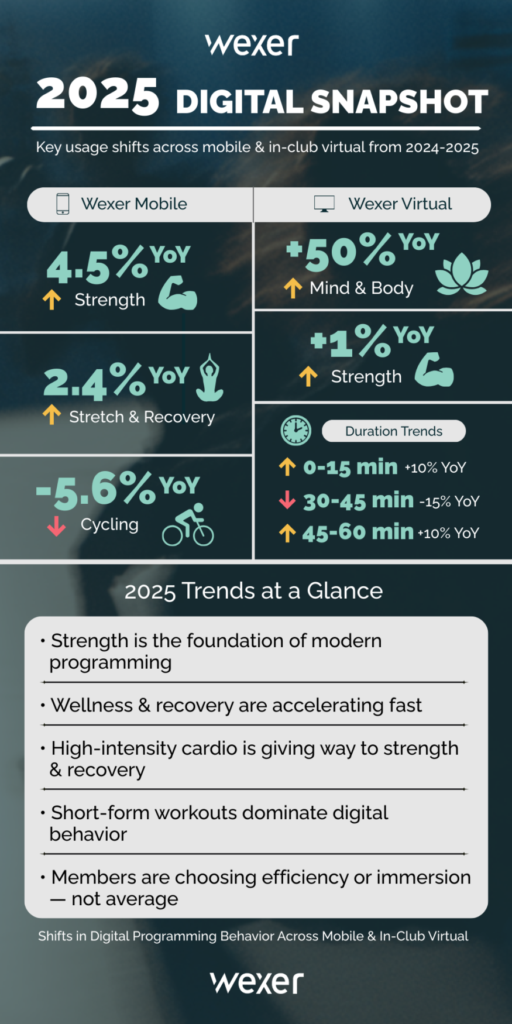
Download The Infographic With Form Below
⬇️
2026 Digital Predictions For Operator Wins
Wexer’s 2026 outlook is less about hype and more about solving real operational gaps while meeting emerging demand.
1. Aqua Is Emerging As In-Club Opportunity
Aqua content is positioned as a major growth lane—especially where staffing and schedule reliability are challenges. It’s also a strong “space activation” play: poolside installs can reduce downtime and expand programming without adding instructor strain.
2. Pilates Reformer Is Moving From Boutique To Standard Offerings
Pilates momentum is already building on Mobile, and reformer demand is expected to keep rising. The prediction is simple: reformer is becoming its own studio category in the mainstream fitness facility mix—similar to the evolution of cycling.
3. Variety And Balance Of Digital Content Provides Operator Advantages
Wexer’s 2025 data shows a flatter curve and a more balanced category mix than ever. The takeaway: the winners in 2026 won’t be the clubs that bet on one trend—they’ll be the clubs that build breadth with purpose, then refresh consistently.
4. Target Content With Audience Segmentation
Expect stronger programming aimed at active aging, ability-based modifications, and women’s health. Digital is moving from “for everyone” to “for me.”
5. AI Will Benefit Digital Content Production
The near-term advantage is speed and scalability: smarter editing, modular builds, faster repurposing. But trust still matters with “local star” fitness influences and recognizable instructors will remain the credibility engine.
What Operators Should Do Now In 2026
If you’re building your 2026 digital strategy right now, start here:
- Audit Your Content Library: are you over-weighted in intensity formats that are losing share?
- Build A “Strength + Recovery” Ecosystem: strength drives starts; recovery drives consistency.
- Program For Polarization: offer short stackable options and intentional long sessions—don’t rely on the middle.
- Watch Emerging Digital Demand Categories: See how formatting for Pilates Reformer and aqua are evolving where digital can solve staffing and space utilization challenges.
2025 made one thing clear: digital fitness is no longer “content on a screen.” It’s a behavior system. And the systems that win are the ones that match how people actually live.
Want to download the infographic and get help auditing your digital content mix to address the 2026 trends? Fill out the form for more information.